El pasado simple cuenta lo que pasó y ya terminó: qué hiciste ayer, cuándo se cayó el servidor, qué cambio provocó el incidente. Con este módulo empieza el nivel A2. Cubre los verbos regulares (con -ed) y sus tres pronunciaciones, los irregulares más usados, las preguntas y negaciones con did, y el pasado de to be. Sigue al módulo 5.
6.1 El pasado de to be: was y were
| Persona | Pasado |
|---|---|
| I / he / she / it | was |
| you / we / they | were |
- I was at the office yesterday.
- The server was down for two hours.
- They were in a meeting.
Negativo: wasn't y weren't. Pregunta: Was it your fault? · Were you there?
Objetivos de aprendizaje Al completar este módulo serás capaz de:
- Conjugar was y were en oraciones afirmativas, negativas e interrogativas
- Formar el pasado simple de verbos regulares aplicando las reglas de -ed
- Distinguir las tres pronunciaciones de -ed (/t/, /d/, /ɪd/) según el sonido final del verbo
- Utilizar los verbos irregulares más frecuentes en contexto técnico para narrar incidentes y cambios
6.2 Verbos regulares: -ed
La mayoría de los verbos forma el pasado agregando -ed, igual para todas las personas:
| Regla | Ejemplos |
|---|---|
| La mayoría: + ed | work, worked · check, checked |
| Termina en -e: + d | update, updated · configure, configured |
| Consonante + y: -ied | try, tried · copy, copied |
| Una sílaba consonante-vocal-consonante: se duplica | stop, stopped · plan, planned |
- I restarted the router.
- We installed the patch last night.
6.3 Las tres pronunciaciones de -ed
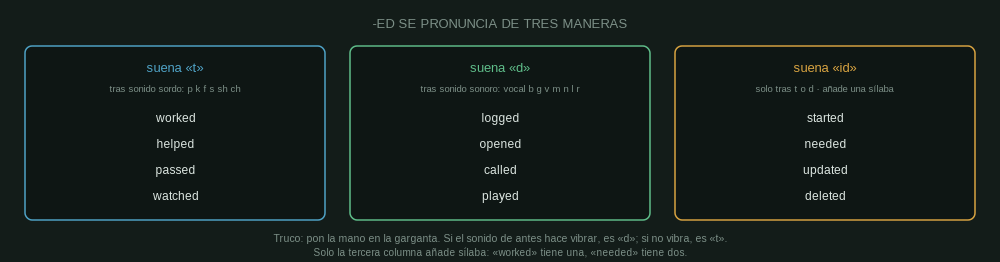
Aunque se escribe siempre igual, -ed suena de tres maneras, y quien habla español suele pronunciarlo siempre como «ed», que es lo que más delata el acento:
| Sonido | Cuándo | Ejemplos |
|---|---|---|
| /t/ | Tras sonidos sordos: p, k, s, sh, ch, f | worked · stopped · fixed · crashed |
| /d/ | Tras sonidos sonoros y vocales | logged · played · called · configured |
| /ɪd/ (una sílaba más) | Solo tras t o d | started · updated · needed · added |
La clave: solo se agrega una sílaba después de t o d. worked tiene una sílaba («uórkt»), no dos; started sí tiene dos.
- The system crashed and we restarted it.
- I fixed the cable and called the user.
6.4 Verbos irregulares más usados
Los verbos más frecuentes son irregulares y hay que memorizarlos:
| Verbo | Pasado | Verbo | Pasado |
|---|---|---|---|
| go | went | see | saw |
| have | had | send | sent |
| do | did | find | found |
| make | made | lose | lost |
| get | got | break | broke |
| take | took | write | wrote |
| say | said | buy | bought |
| tell | told | think | thought |
| know | knew | run | ran |
| come | came | set | set |
Ojo con la pronunciación: said suena «sed», no «seid»; read en pasado suena «red», igual que el color.
6.5 Negativo y preguntas con did
El auxiliar del pasado es did, igual para todas las personas, y con él el verbo vuelve a su forma base:
| Ejemplo | |
|---|---|
| Negativo | I didn't change anything. (no |
| Pregunta | Did you restart the server? |
| Respuesta corta | Yes, I did. / No, I didn't. |
| Con palabra interrogativa | What did you do? · When did it start? |
I didn't change anything es probablemente la frase más dicha después de un incidente. Fíjate en que no lleva -ed: el pasado ya lo marca didn't.
6.6 Expresiones de tiempo del pasado
| Expresión | Significa |
|---|---|
| yesterday | ayer |
| last night / last week | anoche / la semana pasada |
| two hours ago | hace dos horas |
| in 2024 | en 2024 |
| this morning | esta mañana (ya terminada) |
ago va después de la cantidad de tiempo: three days ago, no ago three days.
6.7 Contar una historia: secuencia
Para ordenar los hechos se usan conectores:
- First, then, after that, finally.
- When une dos hechos: When I arrived, the system was down.
Un relato completo para escuchar:
- Yesterday at nine, users reported that the website was slow. First, we checked the logs. Then we found a problem with the database. We restarted the service and everything worked again.
6.8 El informe de un incidente
En inglés técnico, el resumen de un incidente (incident report o postmortem) se escribe en pasado simple:
| Parte | Ejemplo |
|---|---|
| Qué pasó | The VPN stopped working at 10:15. |
| Impacto | About fifty users couldn't connect. |
| Causa | An expired certificate caused the outage. |
| Solución | We renewed the certificate and restarted the service. |
outage (corte o caída del servicio) y root cause (causa raíz) son palabras clave de estos informes.
6.9 Errores típicos
| Incorrecto | Correcto |
|---|---|
| I didn't change it. | |
| Did you see the email? | |
| two days ago | |
| I went home. | |
| «uor-ked» (dos sílabas) | worked (una sílaba) |
6.10 Resumen del módulo
- Pasado de to be: was / were; negativo wasn't / weren't.
- Regulares con -ed: updated, tried, stopped.
- -ed suena /t/ (fixed), /d/ (logged) o /ɪd/ solo tras t y d (started).
- Irregulares clave: went, had, did, made, got, took, said, sent, found, broke.
- Negativo y pregunta con did + verbo base: I didn't change anything. · When did it start?
- ago va después: two hours ago.
- Informe de incidente en pasado: qué pasó, impacto, causa (root cause) y solución.