El presente continuo habla de lo que está pasando ahora mismo o en estos días: «estoy revisando los », «el servidor se está reiniciando». En soporte y en reuniones se usa todo el tiempo para informar el estado de un trabajo. Este módulo cubre cómo se forma, cómo se diferencia del presente simple, los verbos que no lo admiten, y repasa a fondo las preguntas. Sigue al módulo 4.
5.1 Cómo se forma
to be + verbo con -ing:
| Persona | Ejemplo |
|---|---|
| I | I'm checking the logs. |
| you / we / they | They're installing the update. |
| he / she / it | The server is restarting. |
- I'm working on it. (estoy en eso: la respuesta estándar cuando preguntan por un ticket)
- We're having some issues with the VPN.
Objetivos de aprendizaje Al completar este módulo serás capaz de:
- Formar oraciones en presente continuo para informar el estado de un trabajo en curso
- Aplicar las reglas ortográficas de la terminación -ing según el tipo de verbo
- Distinguir cuándo usar presente simple y cuándo presente continuo en contextos de soporte técnico
- Identificar los verbos de estado (stative verbs) que no admiten la forma continua
5.2 Cómo se escribe el -ing
| Regla | Ejemplos |
|---|---|
| La mayoría: + ing | work, working · check, checking |
| Termina en -e muda: se quita la e | use, using · write, writing |
| Una sílaba, consonante-vocal-consonante: se duplica la última | run, running · stop, stopping · plan, planning |
| Termina en -ie: cambia a -y | die, dying · lie, lying |
La terminación -ing se pronuncia con una nasal suave, sin «g» fuerte al final: running, no «rannin-g».
5.3 Negativo y preguntas
| Ejemplo | |
|---|---|
| Negativo | I'm not using the printer. · It isn't working. · They aren't answering. |
| Pregunta | Are you using the meeting room? · Is it still running? |
| Respuesta corta | Yes, I am. · No, it isn't. |
- What are you working on?
- Is anyone using this laptop?
5.4 Presente simple o presente continuo
| Presente simple | Presente continuo |
|---|---|
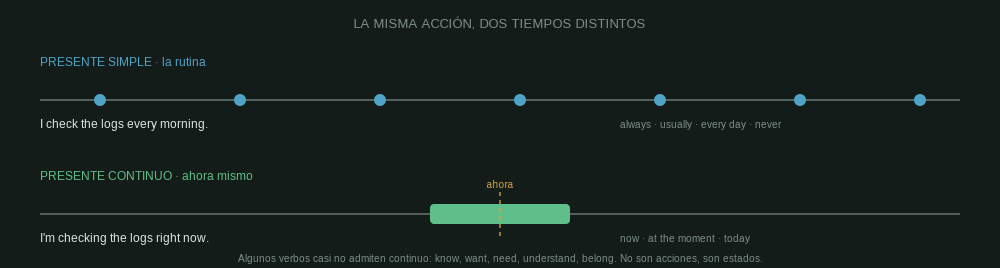
| Hábitos, hechos, cómo funcionan las cosas | Lo que pasa ahora o en este período |
| I usually work from home. | Today I'm working at the office. |
| The script runs every night. | The script is running right now. |
| She speaks English. | She's speaking with a client. |
Expresiones que acompañan al continuo: now, right now, at the moment, today, this week, currently.
El continuo también se usa para situaciones temporales y para cambios en curso: We're migrating to the cloud this year. · Attacks are getting more sophisticated.
5.5 Verbos que casi no van en continuo
Algunos verbos describen estados, no acciones, y se usan en presente simple aunque se refieran a ahora:
| Tipo | Verbos | Correcto |
|---|---|---|
| Mente | know, understand, believe, remember | I don't understand. (no |
| Preferencia | like, want, need, prefer | I need help. |
| Posesión | have (tener), own, belong | It has 16 GB of RAM. |
| Sentidos | see, hear | I can't hear you. |
have sí va en continuo cuando es una acción y no posesión: We're having a meeting. · I'm having lunch.
5.6 Las preguntas con palabra interrogativa
| Palabra | Pregunta por | Ejemplo |
|---|---|---|
| What | qué | What are you doing? |
| Where | dónde | Where is the server room? |
| When | cuándo | When does the backup run? |
| Who | quién | Who is responsible for this? |
| Why | por qué | Why is it so slow? |
| How | cómo | How does it work? |
| Which | cuál (entre opciones) | Which port is it using? |
| How many / How much | cuántos | How many users are affected? |
El orden es siempre: palabra interrogativa + auxiliar + sujeto + verbo. Why is it so slow? · What does the error say?
5.7 Preguntas de soporte técnico
Las preguntas de un primer contacto con un usuario, en presente simple y continuo:
- What seems to be the problem?
- What are you trying to do?
- What error message are you seeing?
- Is it happening right now?
- Does it happen every time?
- Are other users having the same problem?
Y respuestas típicas de un usuario: My laptop isn't connecting to the Wi-Fi. · The application keeps crashing.
keep + -ing significa «seguir haciendo algo una y otra vez», y aparece mucho al describir fallas: It keeps restarting.
5.8 Informar el estado de un trabajo
En una reunión diaria o en un ticket se informa con el continuo:
- I'm currently working on the firewall rules.
- We're waiting for the vendor's response.
- The team is testing the new version.
- Everything is working fine now.
Y para cerrar: It's fixed. · It's working again.
5.9 Errores típicos
| Incorrecto | Correcto |
|---|---|
| I'm working now. | |
| I know the answer. | |
| Where are you going? | |
| It isn't working. | |
| I work here every day. |
5.10 Resumen del módulo
- to be + -ing para lo que pasa ahora o en este período: I'm working on it.
- Escritura del -ing: se quita la e (using) o se duplica la consonante (running).
- Simple = hábito o hecho; continuo = ahora o temporal: The script runs every night / is running right now.
- Verbos de estado (know, need, like, have de posesión) van en simple: I don't understand.
- Orden de las preguntas: palabra + auxiliar + sujeto + verbo: What are you trying to do?
- Soporte: Does it happen every time? · It keeps crashing.
- Informar estado: We're waiting for the vendor's response.