La voz pasiva es el idioma de la documentación técnica, los avisos de seguridad y los informes de incidentes: pone el foco en lo que le pasa a algo, no en quién lo hizo. «The server was compromised», «passwords are encrypted». Entenderla sin traducirla palabra por palabra es una habilidad clave para leer inglés técnico. Sigue al módulo 12.
13.1 Activa frente a pasiva
En la voz activa, el sujeto hace la acción. En la voz pasiva, el sujeto recibe la acción:
- Activa: The team deployed the update. (el equipo hizo la acción)
- Pasiva: The update was deployed. (el foco es la actualización, no quién la hizo)
El inglés usa la voz pasiva mucho más que el español, sobre todo cuando quién hizo la acción no importa, no se sabe, o se quiere evitar nombrarlo (muy común en informes de seguridad, para no señalar a una persona).
13.2 Cómo se forma
to be (en el tiempo que corresponda) + participio pasado:
| Tiempo | Activa | Pasiva |
|---|---|---|
| Presente simple | The system checks passwords. | Passwords are checked. |
| Pasado simple | Someone hacked the server. | The server was hacked. |
| Presente perfecto | We have fixed the bug. | The bug has been fixed. |
| Futuro | We will update the policy. | The policy will be updated. |
| Modal | You must encrypt the data. | The data must be encrypted. |
Objetivos de aprendizaje Al completar este módulo serás capaz de:
- Transformar oraciones de voz activa a pasiva en los tiempos verbales principales
- Identificar la voz pasiva en documentación técnica, informes de incidentes y avisos de seguridad
- Distinguir cuándo la voz pasiva es preferible a la activa en escritura técnica profesional
- Interpretar oraciones pasivas con modales (must be encrypted, should be configured) en políticas y manuales
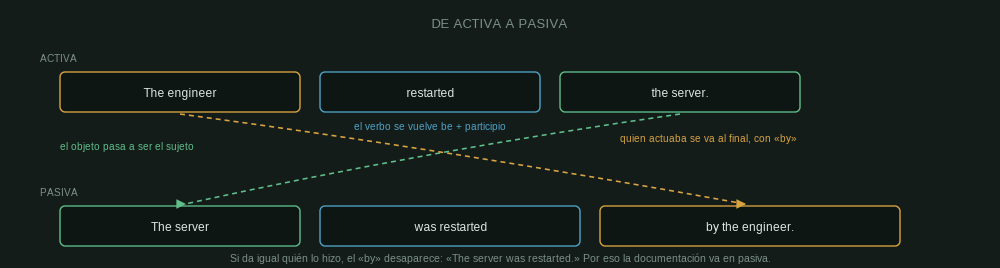
13.3 Mencionar quién hizo la acción: by
Cuando sí importa decir quién hizo la acción, se agrega by:
- The vulnerability was discovered by a security researcher.
- The patch was released by the vendor.
Si no se menciona a nadie, es porque no importa, no se sabe o no se quiere decir: The data was leaked. (no se dice quién la filtró, o no se sabe).
13.4 Por qué se usa tanto en documentación y seguridad
| Razón | Ejemplo |
|---|---|
| El objeto es lo importante, no el agente | The connection is encrypted. |
| El agente es obvio o genérico ("el sistema") | The request is processed automatically. |
| El agente no se sabe (un atacante) | The server was compromised last week. |
| Es más formal e impersonal | Visitors are required to sign in. |
En un informe de seguridad: Three accounts were affected. The access was revoked immediately. The incident has been reported to the authorities.
13.5 Pasiva con modales: must be, should be, can be
Combinar modales con pasiva es muy frecuente en políticas e instrucciones:
- Passwords must be changed every ninety days.
- This field should be filled in before submitting.
- The configuration can be changed in the settings.
- Sensitive data mustn't be stored in plain text.
13.6 Leer la pasiva sin traducir palabra por palabra
Al leer documentación, conviene identificar primero el verbo to be y el participio, y pensar «¿a quién/qué le pasa esto?» en vez de traducir de atrás para adelante:
- The server is monitored 24/7. → el servidor es monitoreado, no «el servidor monitorea».
- Logs are stored for ninety days. → los se guardan (son guardados).
- This option is disabled by default. → esta opción viene deshabilitada.
13.7 Get + participio: la pasiva informal
En conversación, se usa a veces get en vez de be para pasivas, sobre todo con algo inesperado o negativo:
- The server got hacked. (más informal que was hacked)
- My account got locked.
- The project got delayed.
Es común al hablar, pero en documentación formal se prefiere to be.
13.8 Convertir activa a pasiva
El objeto de la frase activa se vuelve el sujeto de la pasiva:
- Activa: The firewall blocks malicious traffic. (sujeto: the )
- Pasiva: Malicious traffic is blocked by the firewall. (sujeto: malicious traffic)
Practica con esta frase: The IT team installed the update. → The update was installed by the IT team.
13.9 Errores típicos
| Incorrecto | Correcto |
|---|---|
| The server was hacked. | |
| Passwords must be changed. | |
| The data is stored in the cloud. | |
| It was discovered by a researcher. | |
| The bug has been fixed. |
13.10 Resumen del módulo
- Pasiva = to be + participio; el sujeto recibe la acción, no la hace: The update was deployed.
- Se forma en cualquier tiempo: is checked, was hacked, has been fixed, will be updated, must be encrypted.
- by agrega quién hizo la acción, cuando importa: discovered by a researcher.
- Se usa mucho en documentación y seguridad porque el agente no importa, no se sabe o se evita nombrar: The server was compromised.
- Modal + pasiva es frecuente en políticas: Passwords must be changed every ninety days.
- get + participio es la versión informal: My account got locked.
- Pensar en el «se» del español ayuda a leer la pasiva sin traducir palabra por palabra.